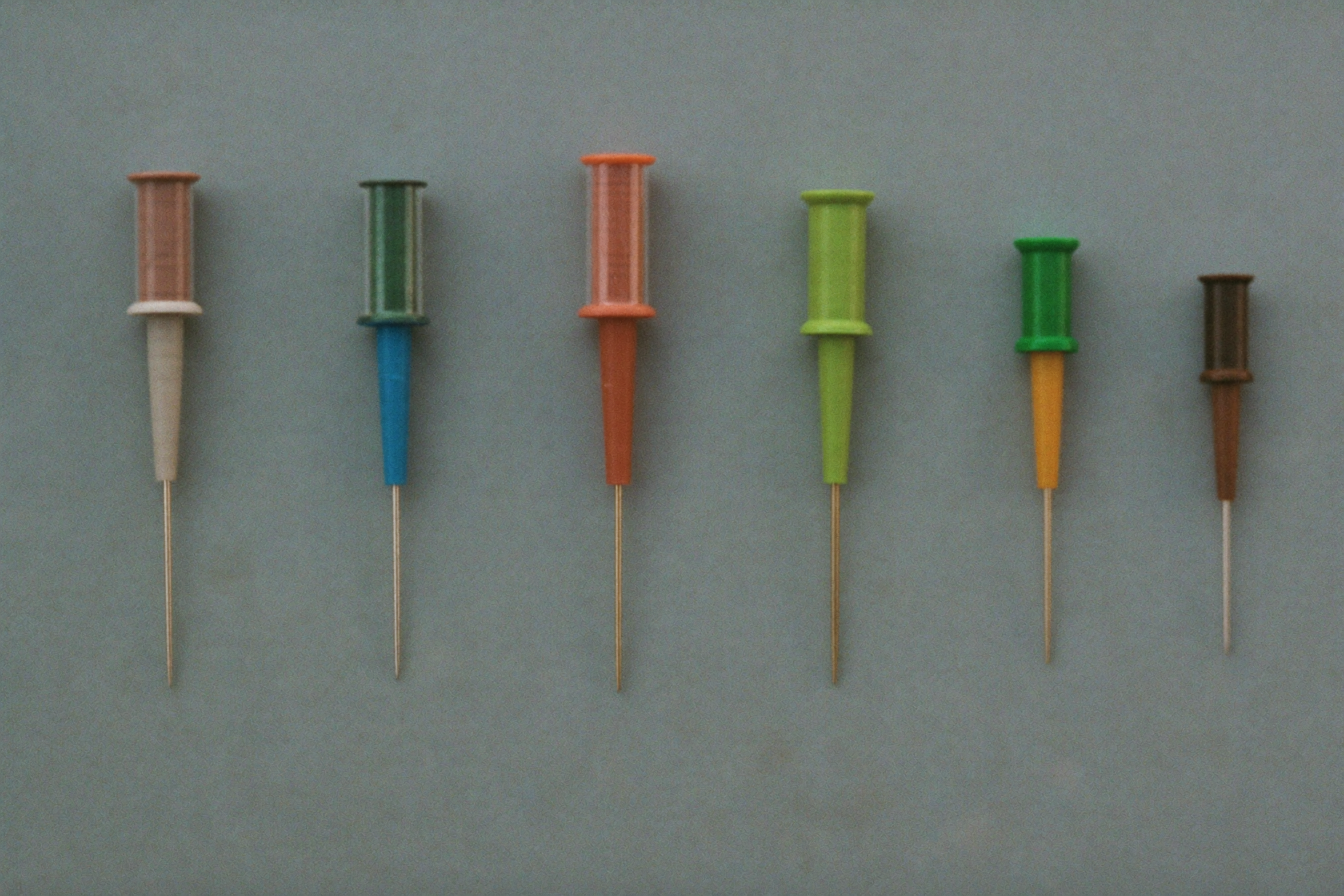
Gauge
Outer diameter
Hub colour
Typical use
14G
2.11mm
Orange
Large bore transfer. Rarely used outside a hospital.
16G
1.65mm
White
Transfer and rapid infusion.
18G
1.27mm
Pink
Drawing up a thick oil. Too wide to inject with.
19G
1.07mm
Cream
Drawing up. Also blunt fill needles.
20G
0.91mm
Yellow
Drawing up, or intramuscular in a large muscle.
21G
0.82mm
Green
The common drawing-up gauge. Also venepuncture.
22G
0.72mm
Black
Intramuscular, or drawing a thinner solution.
23G
0.64mm
Blue
Intramuscular. A frequent choice for the deltoid.
25G
0.51mm
Orange
Intramuscular in a smaller muscle, or intradermal.
26G
0.46mm
Brown
Fine intramuscular and subcutaneous.
27G
0.41mm
Grey
Subcutaneous. Noticeably more comfortable.
29G
0.34mm
Red
Insulin syringes. Fills fastest of the fine gauges.
30G
0.31mm
Yellow
Insulin syringes and pen needles. The middle choice.
31G
0.26mm
Violet
Insulin syringes and pen needles. Least sensation.
32G
0.23mm
Bright green
Pen needles. The finest in common use.
33G
0.21mm
Blue
Speciality pen needles.
34G
0.18mm
Ochre
The finest made. Speciality use only.
Hub colours follow ISO 6009. Manufacturers occasionally differ, so read the carton rather than trusting the colour alone. Diameters are nominal outer diameter.
Shop the gauges
Once you know the number.
Every gauge in the chart, priced and in stock, with no account needed to see what it costs.
Still not sure which one you want?
Three plain questions, no medical words, and the Gauge Finder picks the gauge and the length for you.